
The engineered flooring wear layer is the top real wood veneer or protective film bonded to a plywood or composite core, and it is the single factor that determines how long a floor lasts and how many times it can be refinished. Builders and contractors who specify flooring without confirming wear layer thickness routinely deliver floors that fail within a decade. The industry term for this veneer in engineered hardwood is the lamella. Understanding lamella thickness, measured in millimeters for hardwood and in mils for luxury vinyl plank, separates a floor that serves a building for 80 years from one that needs full replacement in 15.
What does engineered flooring wear layer thickness actually determine?
Wear layer thickness is the primary value metric for engineered floors, outweighing total plank thickness in every meaningful performance category. A plank can be 18mm thick overall, yet carry a lamella of only 1.2mm. That 1.2mm is the entire service life of the floor’s surface.
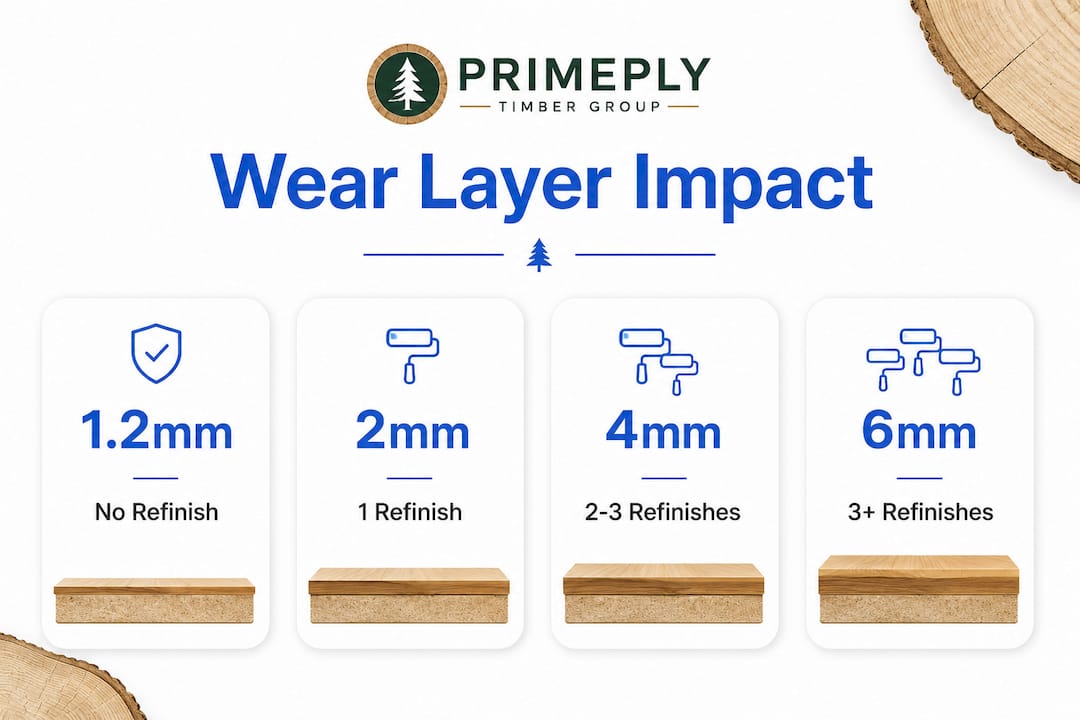
Wear layer thickness dictates refinishing potential and lifespan, ranging from 1.2mm at the entry level to 6mm at the premium end. A 1.2mm lamella supports a floor life of 15–25 years with no refinishing. A 4–6mm lamella allows 5 or more full refinish cycles, extending service life to 50–100+ years. That range represents the difference between a floor that gets replaced and a floor that gets passed down.
One misconception builders encounter constantly is that a thicker total plank means a more durable surface. It does not. Total plank thickness ranges from 10–20mm, but the wear layer can be under 2mm, and completely unsuitable for sanding. The core provides structural stability. The lamella provides surface life. Conflating the two leads to costly specification errors.
Pro Tip: Always request the lamella thickness separately from total plank thickness when reviewing product submittals. If a manufacturer lists only overall thickness, treat that product as non-refinishable until proven otherwise.
How thickness tiers translate to refinish cycles and project cost
A single professional sanding pass removes approximately 0.75–1mm of the wear layer. That figure sets a hard ceiling on how many times any engineered floor can be sanded. A 2mm lamella supports one refinish at most. A 4mm lamella supports three to four full sands. A 6mm lamella supports five or more.
| Wear layer thickness | Refinish cycles | Estimated floor lifespan | Best application |
|---|---|---|---|
| 1.2mm | 0 | 15–25 years | Short-term rental, budget residential |
| 2mm | 1 | 25–35 years | Standard residential, low-traffic commercial |
| 3mm | 2–3 | 35–50 years | Active households, mid-grade commercial |
| 4mm | 3–4 | 50–75 years | Long-term residential, higher-traffic commercial |
| 6mm | 5+ | 75–100+ years | Forever homes, premium commercial |
The cost-per-year calculation favors thicker wear layers on any project expected to last more than 20 years. A 4mm product costs more upfront, but three refinishes at $2–4 per square foot each still undercut full floor replacement. Builders who present this math to clients close more premium specifications.
Surface hardness is a separate variable. Scratch resistance depends more on factory finishes than on wear layer thickness alone. Aluminum oxide and UV-cured urethane coatings applied at the mill protect against daily abrasion. A thick lamella without a quality factory finish will show scratches faster than a thinner lamella with a hard topcoat. Specify both.
For luxury vinyl plank, the measurement unit shifts entirely. LVP wear layers are measured in mils, where one mil equals one thousandth of an inch. A 6 mil layer is entry-level. A 12 mil layer suits standard residential use. A 20–22 mil layer covers active households and light commercial applications. A 28+ mil layer is heavy commercial grade. A 20 mil LVP wear layer and a 4mm hardwood lamella both represent premium protection in their respective product categories.
Why measurement units cause specification errors
Wear layers in hardwood are measured in millimeters. Wear layers in vinyl plank are measured in mils. The units are not interchangeable, and confusing the two leads directly to specification errors. A 20 mil LVP layer converts to roughly 0.5mm. A 4mm hardwood lamella is eight times thicker. Comparing them as raw numbers without noting the unit produces completely wrong conclusions.
The most common specification pitfalls builders face include:
- Listing only total plank thickness on project documents, which tells subcontractors and suppliers nothing about refinishability
- Accepting products without a technical data sheet that explicitly states lamella or wear layer thickness in the correct unit
- Treating “commercial grade” as a wear layer spec when it often refers to finish hardness or AC rating, not lamella depth
- Failing to specify a minimum lamella thickness in the contract, which opens the door to value-engineered substitutes
Builders should specify minimum lamella thickness and reference standards like EN 13647 in project specifications. EN 13647 covers classification and requirements for wood floor coverings and gives you a defensible benchmark when challenging a product substitution. Without a named standard in the spec, a supplier can swap a 4mm lamella product for a 1.5mm product and claim compliance.
Reading a technical data sheet correctly takes 60 seconds. Look for “lamella thickness,” “wear layer,” or “top layer” listed as a standalone measurement. If the sheet shows only “overall thickness” or “total thickness,” contact the manufacturer directly before approving the product.
How to select the right wear layer for each project type
Matching wear layer thickness to project type is not a one-size-fits-all decision. The right specification depends on traffic load, expected floor lifespan, refinishing budget, and the client’s long-term plans for the building.
-
Long-term residential (owner-occupied, 20+ year horizon): Specify a minimum 4mm lamella for engineered hardwood. This supports multiple refinish cycles and delivers a total cost of ownership comparable to solid wood. For plywood-over-joist subfloors, a 4mm or thicker lamella provides refinishing performance that matches solid hardwood.
-
Rental and short-term residential: A 2–3mm lamella is appropriate. These floors will not be refinished by the owner. Prioritize a hard factory finish over lamella depth, and consider 20 mil LVP as a cost-effective alternative that handles tenant traffic without refinishing requirements.
-
Light commercial (offices, boutique retail, hospitality): Specify 20–22 mil for LVP or 3–4mm for engineered hardwood. Traffic volume in these spaces exceeds residential norms, and the floor needs to hold up through lease cycles without refinishing.
-
Heavy commercial (healthcare, education, high-traffic retail): LVP at 28+ mil is the standard. Engineered hardwood is rarely the right choice here unless the design program specifically requires it, and a 6mm lamella with commercial-grade finish is the minimum.
-
Mixed-use or phased projects: Specify by zone. A lobby gets 28 mil LVP or 4mm hardwood. A private office corridor can use 12 mil LVP or 2mm hardwood. Blanket specifications waste budget in low-traffic zones and under-specify in high-traffic ones.
Pro Tip: When a client’s budget forces a thinner wear layer, specify a harder factory finish to compensate. A 2mm lamella with an aluminum oxide topcoat outperforms a 3mm lamella with a soft oil finish in daily scratch resistance.
Wear layer selection should match the project’s lifespan and maintenance budget. Thicker lamella products are cost-effective only when the floor will actually be refinished. A 6mm lamella in a rental unit that gets replaced every 10 years is wasted specification.
What are the best maintenance practices for engineered wear layers?
Maintenance decisions must align with the wear layer thickness already installed. The two primary options are screen and recoat, and full sanding and refinishing. Choosing the wrong method destroys the floor.
Screen and recoat lightly abrades the existing finish without cutting into the wood. It is the correct method for wear layers under 2mm, where a full sand would risk cutting through to the core. Screen and recoat refreshes the surface sheen, fills minor surface scratches, and extends floor life by 5–10 years without removing any lamella material. It costs significantly less than a full refinish.
Full sanding removes 0.75–1mm per pass and is appropriate only when the wear layer is thick enough to survive it. A professional assessment before any sanding job is non-negotiable. Sanding a 1.5mm lamella floor without measuring remaining thickness first is how builders and flooring contractors damage floors that cannot be repaired.
Common maintenance mistakes that accelerate wear layer degradation:
- Steam mops force moisture into the lamella and core joints, causing delamination and cupping. Never use them on engineered floors.
- Improper cleaners strip factory finishes and leave the lamella exposed. Use pH-neutral, hardwood-specific cleaners only.
- Skipping felt pads under furniture legs concentrates point loads that scratch through factory finishes faster than foot traffic.
- Delaying recoating until the finish is fully worn exposes raw wood to moisture and staining, which forces a full sand instead of a simple recoat.
Signs that a wear layer is exhausted include visible raw wood grain through the finish, gray discoloration from moisture penetration, and areas where sanding has already reached the adhesive layer above the core. At that point, replacement is the only option. No refinishing method recovers a floor once the lamella is gone.
Key Takeaways
Wear layer thickness is the single most important specification in any engineered flooring project, determining refinish cycles, total lifespan, and true cost of ownership.
| Point | Details |
|---|---|
| Lamella thickness drives lifespan | A 1.2mm wear layer lasts 15–25 years; a 6mm wear layer supports 50–100+ years of service. |
| One sand removes 0.75–1mm | A 2mm wear layer supports only one refinish before the core is at risk. |
| Units differ by product type | Hardwood wear layers are measured in millimeters; LVP wear layers are measured in mils. |
| Specify minimums in contracts | Reference EN 13647 and list minimum lamella thickness to prevent value-engineered substitutions. |
| Match thickness to project type | Rental and short-term projects need 2–3mm; long-term residential and commercial need 4mm or more. |
Why builders who ignore wear layer specs pay twice
I have reviewed enough flooring submittals to know that wear layer specification is where most budget-driven projects quietly fail. The floor looks fine at handover. The problem shows up in year eight when the client calls asking why their floor cannot be refinished. The answer is always the same: the lamella was 1.5mm, nobody checked, and now the entire floor needs replacement.
The industry has made this easier to get wrong by marketing total plank thickness as the headline spec. A 15mm plank sounds substantial. It is, structurally. But if 13mm of that is plywood core, the floor has no refinishing life at all. Builders who do not know to ask for lamella thickness separately will keep specifying floors that disappoint clients.
The other thing I see consistently is clients confusing scratch resistance with wear layer depth. A floor with a hard aluminum oxide finish and a 2mm lamella will look better longer than a floor with a soft oil finish and a 4mm lamella, at least for the first decade. The finish protects daily. The lamella protects over decades. Both matter and they do different jobs.
My recommendation to any builder specifying engineered flooring: put lamella thickness and finish type in the spec document as separate line items. Reference EN 13647. Reject any submittal that does not include a technical data sheet with explicit lamella thickness. That one habit eliminates the most common and most expensive flooring failure mode in residential and commercial construction.
— John
Engineered flooring specifications from Woodproducts
Woodproducts, part of Primeply Timber Group, supplies engineered flooring products built to verified technical standards for residential and commercial construction. Every product comes with full technical data sheets that list lamella thickness, core construction, and finish specifications, so builders can specify with confidence and avoid substitution disputes on site.

Woodproducts works directly with builders, distributors, and manufacturers on bulk orders and project-specific sourcing. The team provides technical consultation on wear layer selection matched to project type, traffic load, and long-term maintenance plans. Contact Woodproducts at woodproducts.co to request product specifications or discuss supply for your next project.
FAQ
What is the minimum wear layer for a refinishable engineered floor?
A minimum of 2mm is required for a single professional refinish. Anything under 2mm should be treated as non-refinishable, since one sanding pass removes 0.75–1mm.
How does LVP wear layer thickness compare to engineered hardwood?
LVP wear layers are measured in mils, not millimeters. A 20 mil LVP layer equals roughly 0.5mm, which is not refinishable but resists daily wear through its factory finish rather than sanding cycles.
What standard should builders reference when specifying wear layers?
EN 13647 covers classification and requirements for wood floor coverings. Referencing it in project specifications prevents suppliers from substituting products with inadequate lamella thickness.
Can screen and recoat extend the life of a thin wear layer?
Screen and recoat is the correct maintenance method for wear layers under 2mm. It refreshes the finish without removing wood, extending floor life without the risk of sanding through to the core.
Does a thicker wear layer mean a harder, more scratch-resistant floor?
No. Scratch resistance depends primarily on the factory finish, such as aluminum oxide or UV-cured urethane coatings, not on wear layer thickness. Thickness determines refinishing potential; finish determines daily surface protection.